An Egyptian anorthosite gneiss (Chephren Diorite) heart amulet, Third Intermediate Period - Late Period, circa 747-332 BC
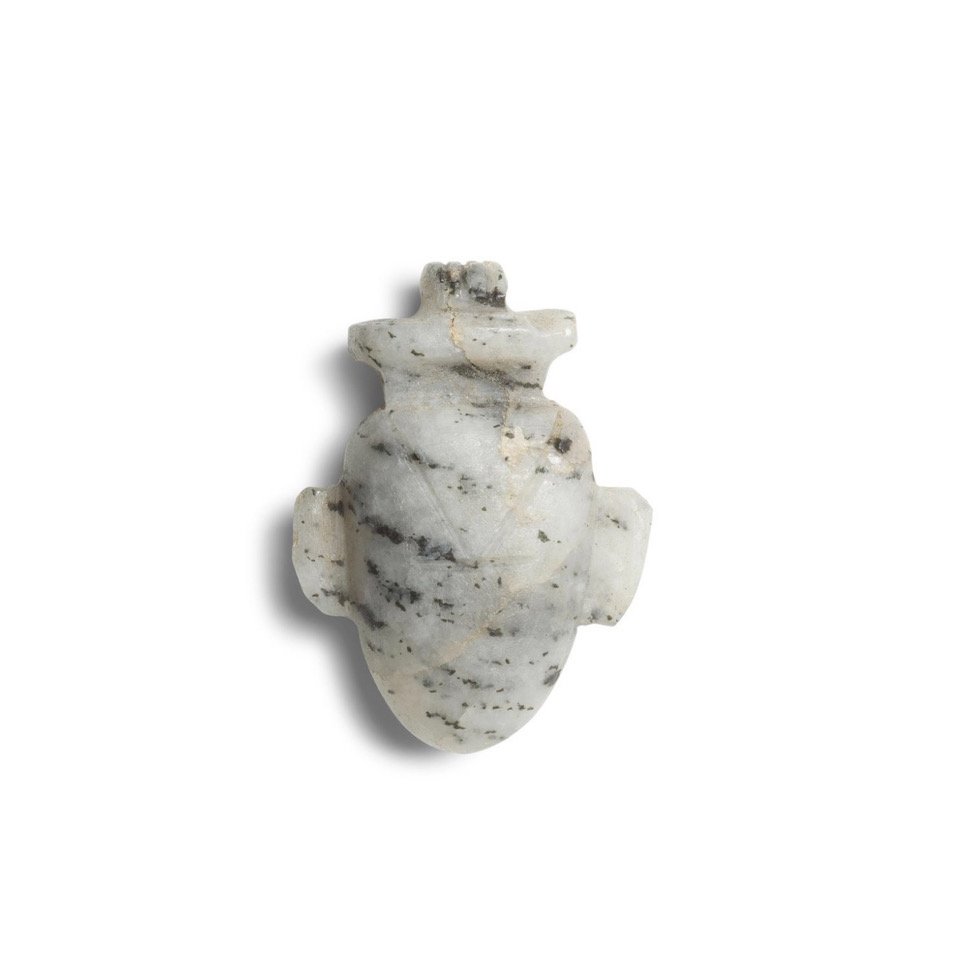
Height: 2.6 cm
Provenance: With Nicolas Koutoulakis (1910-1996), Paris and Geneva; thence by descent.
For the ancient Egyptians, the heart (ib) was the centre of thought and the driver of feelings and actions. Thus, it was the organ, which remembered the deeds done in life, that played a significant role in helping the deceased to reach the afterlife.
Such amulets are typically represented as an ovoid vessel, broader at the top, with a handle-like element on each side, perhaps indicating veins and arteries, and a flared and flattened rim at the top. The top of this dark stone amulet has a ribbed pseudo-loop, thus it may have been placed on the body.
The most important guide to the afterlife, the Book of the Dead, which includes the Weighing of the Heart Ceremony, suggests the wearing of heart amulets, and they became widespread after the introduction of the Book of the Dead in the New Kingdom, playing a significant role within grave goods until the end of the Pharaonic period. Cf: C. Andrews, Amulets of Ancient Egypt, 1994. p. 72-73.