A Roman marble cinerary urn inscribed ‘Hail Holy Soul of Pamphile’, circa 1st century AD
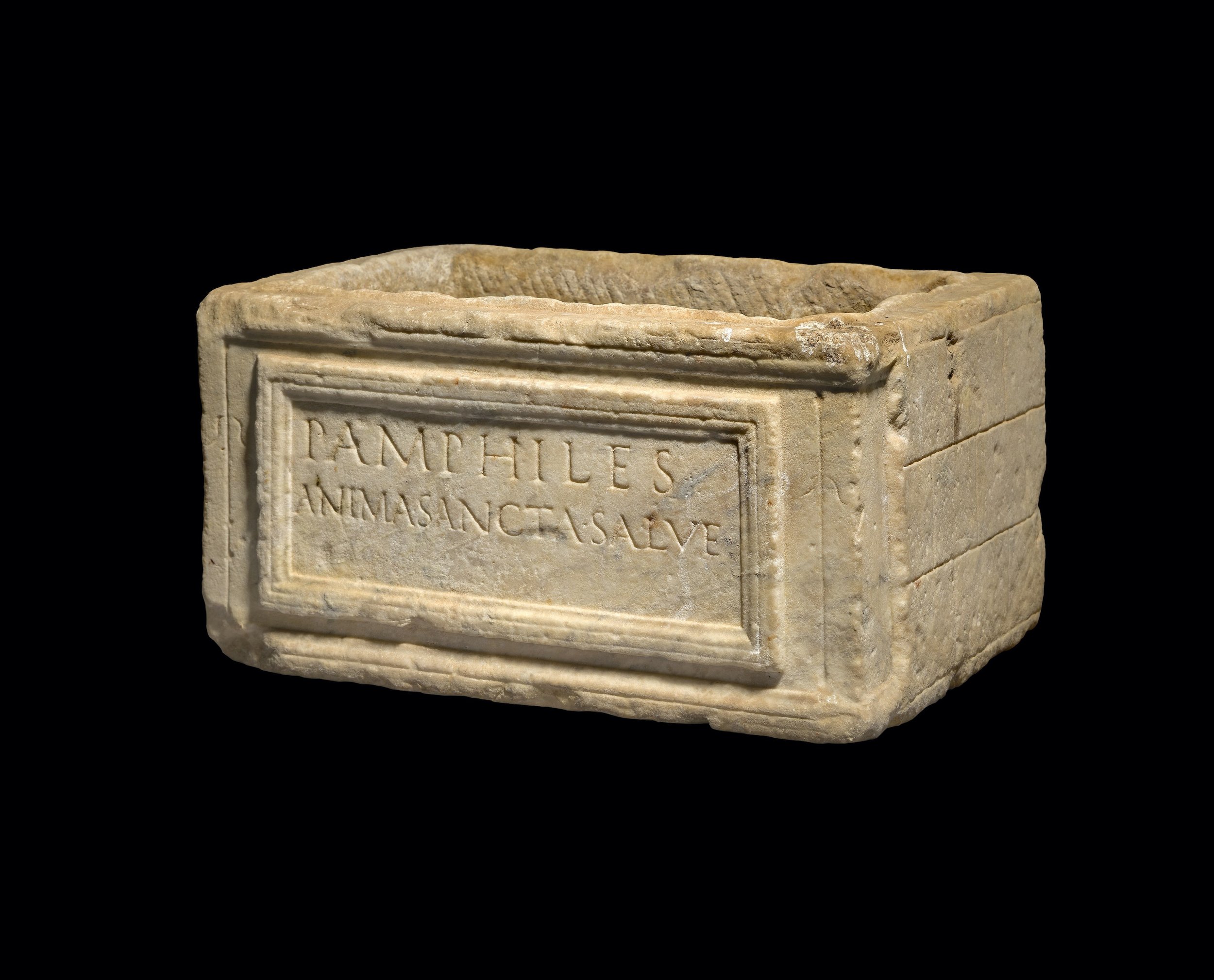

Height: 21.6 cm; length: 38.7 cm; depth: 26.7 cm
Engraved in front between corner pilasters and within a framed rectangular panel with two lines of Latin inscription reading Pamphiles / anima sancta salve ("Hail, holy soul of Pamphile"), the sides carved with imitation ashlar masonry and fitted with mortises and remains of lead clamps for attachment of the now missing lid.
Provenance:
The artist Girolamo Odam (1681 – 1741), Rome
The sculptor Carlo Antonio Napolioni (1675 – 1742), Rome, official restorer to the Museo Capitolino
Sotheby's, London, 17 – 18 July 1985, lot 588
Martha Hyder Collection
Published:
Antonio Francisco Gori, Codex Marucellianus A, 245 (letter dated 15 June 1740, probably from J. Odam).
Scipione Maffei, Museo Veronense, Verona, 1749, p. 281, no. 2.
Corpus InscriptionumLatinarum, Vol. VI: Inscriptiones Urbis Romae latinae, part 3, Berlin, 1886, no. 23740.
Literature:
The reference to ‘holy soul’ is unusual in this pagan context. Such concepts as 'soul', 'sanctity' and 'innocence' on epitaphs do appear in pagan contexts but become particularly prevalent in the later Roman, early Christian period.
Paleographically the letters of the inscription allow us to date the urn to the 1st century AD. For example the letter ‘P’ that appears twice has a relatively open curve, the curve in such letters did not close completely until circa 100 AD.