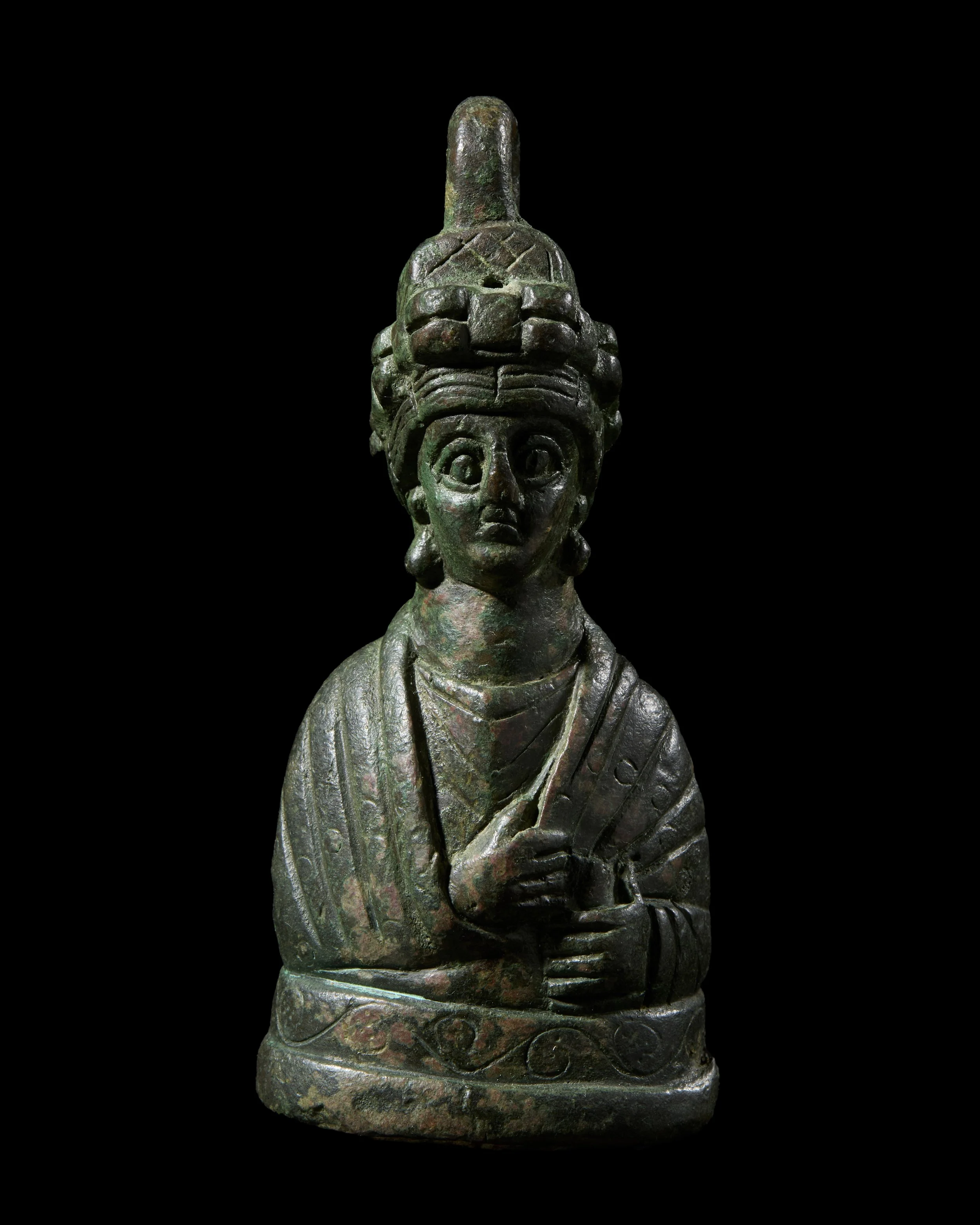
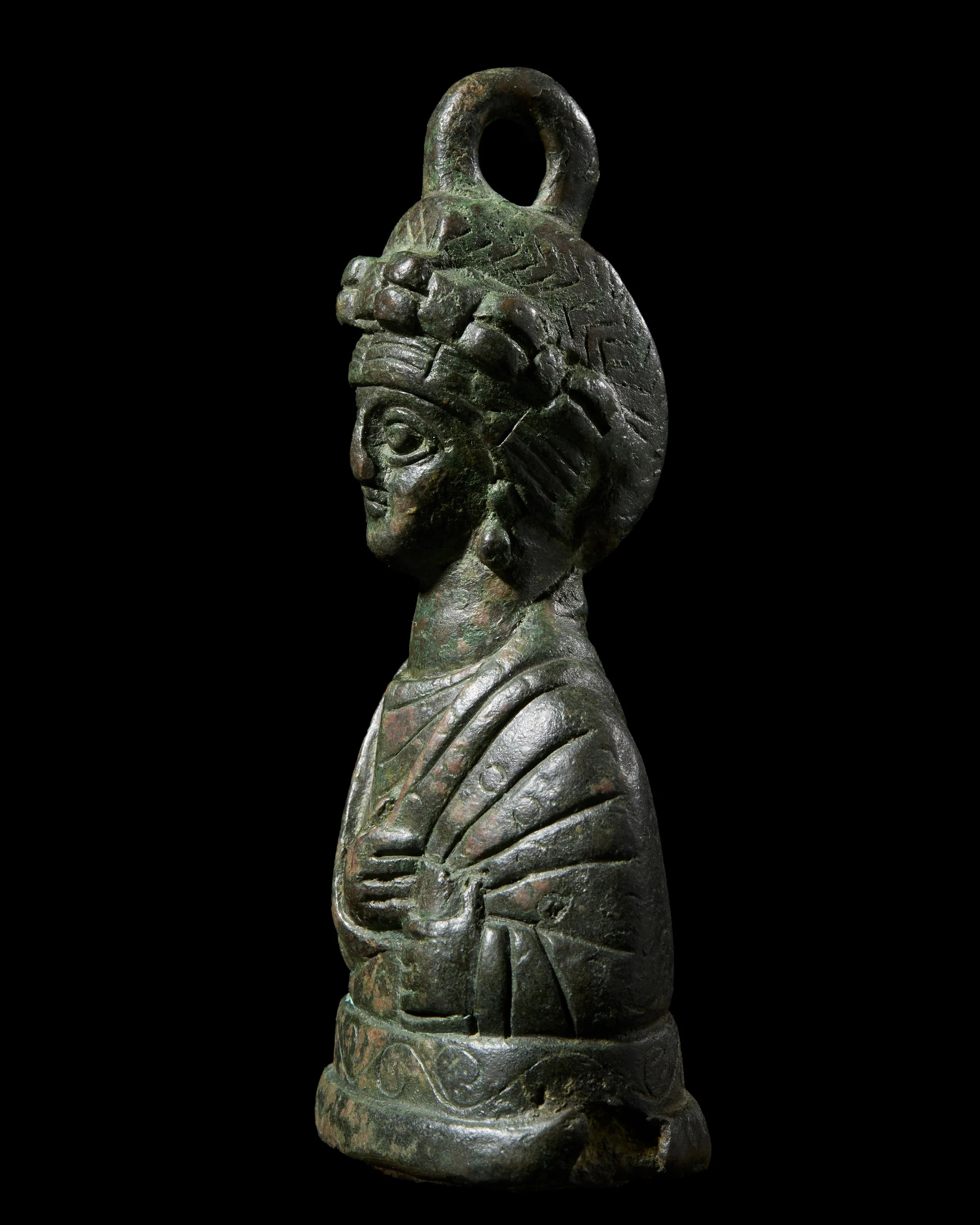
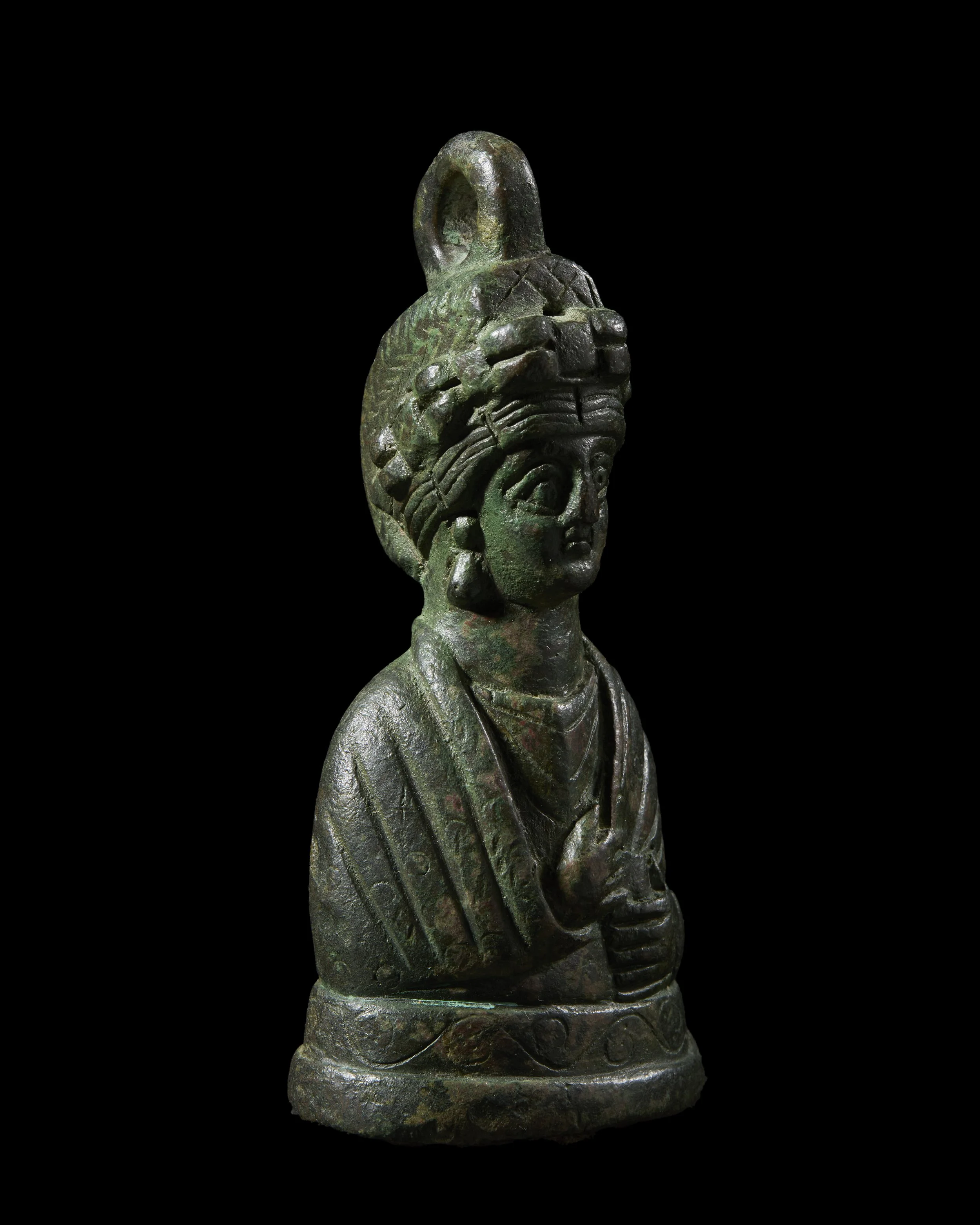
A Byzantine bronze steelyard weight of an Empress
Circa 5th - 6th century AD
Height: 15 cm
Provenance:
Bonhams, London, 30 April 1996, lot 67
Property from a Distinguished Family Collection, acquired from the above
Probably the Empress Aelia Eudocia (AD 421-443), also known as Saint Eudocia, wife of Theodosius II (AD 402-450)
In the form of a bust of an empress, enveloped in a tightly wrapped cloak, her right hand emerging from beneath the folds and held against her chest. Wearing an imperial diadem and drop earrings, her oval face with almond-shaped articulated eyes beneath heavy lids, her hair centrally-parted and pulled back and folded up from the nape of her neck and arranged in two large braids fastened atop her head, surmounted by a suspension loop above; filled with lead
The Empress Aelia Eudocia was born Athenais, the daughter of Leontius, a pagan philosopher in Athens. Before she and the Emperor were married, Athenais was baptised a Christian and took the name Eudocia. In the latter part of her reign, her relationship with her husband deteriorated and Eudocia spent the last years of her life in Jerusalem. A prolific poet, she devoted herself to writing, and overseeing the construction of several impressive churches.
For a similar steelyard weight of an Empress cf. Byzanz. Das licht aus dem Osten, Exhibition catalogue, Diocesan Museum Paderborn, 2001, p.248, no. III.26. A significant number of weights surviving from this period are in the form of an Empress bust, which denoted an imperial guarantee of the fairness of the commercial transaction taking place.
See A. McClanan, Representations of Early Byzantine Empresses: Image and Empire. The New Middle Ages, New York, 2002, pp. 41–45 and I. Kalavrezou, Byzantine Women and their World, Cambridge, MA: Harvard Art Museums, 2003, pp. 53–56.
£ 6,500.00